
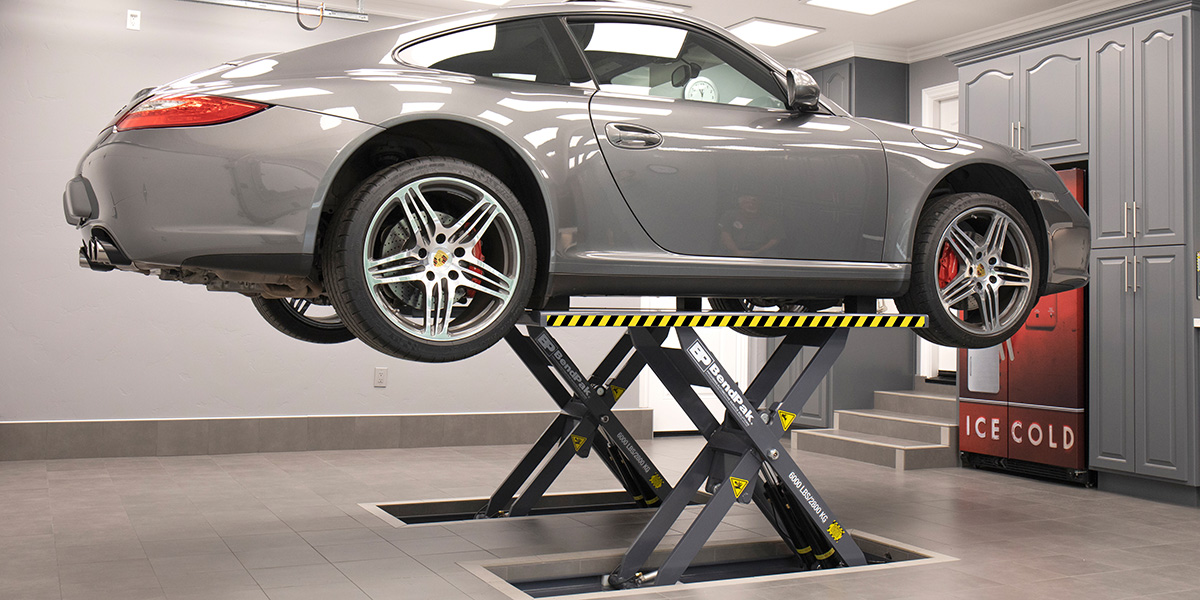
Scissor lifts raise vehicles in a straight vertical path so technicians can work at a set height. This ensures teams can service brakes, suspension, tires, and under-car systems with clear access.
The choice of lift affects how efficiently a shop runs. The right model matches capacity and rise height, fits wheelbase and platform style, aligns with your power and floor conditions. It also uses clear controls and lock systems that keep work moving and safe.
This guide features some of the best scissor-lift brands available, including key features to consider so you can match a lift to your vehicles, space, and budget.
What is a Scissor Lift?
Scissor lifts raise a vehicle up using scissor legs powered by hydraulic cylinders and an electric motor. They come as pad lifts that touch the car’s lifting points or as drive-on runway lifts. Shops can install them on the floor or set them in the ground.
Technicians use these lifts for everyday work like tires, brakes, oil changes, inspections, and alignments. Runway alignment lifts include turn plates and slip plates so the wheels can steer and slide during adjustments. Bridge jacks on the runways let you lift the wheels off the tracks for brake or suspension work.
Scissor lifts come in different types depending on the work to be done, the space available, and the required height. Here are a few types of scissor lifts:
- Low-rise scissor lifts: These lifts raise a vehicle a few feet for quick work, such as tire, brake, and collision repair. They engage the frame or body perimeter and move straight up, and some use compressed air or small electric-hydraulic power units.
- Mid-rise scissor lifts: These types of lifts provide more clearance than low-rise models while remaining compact for general service. Typical models lift roughly 36–48 inches and use electric-hydraulic power with mechanical safety locks.
- Full-rise scissor lifts: These are drive-on runway lifts used for alignment and full under-vehicle access. They reach standing working height, commonly around 70–77 inches depending on model.
Best Scissor Lift Manufacturers and Brands
The scissor lift brand you choose affects safety, downtime, and how fast your shop gets work done. Here are some top manufacturers and brands to consider.
- BendPak

BendPak is one of the most recognized lift manufacturers in the industry, with a long history of building heavy-duty automotive service equipment for professional shops and serious home garages. Their scissor lifts follow the same pattern: solid steel construction, careful attention to safety systems, and models that cover quick service, detailing, and full undercar work.
Through Wrenchers, BendPak’s scissor lineup includes low-rise models for tire and brake work, portable mid-rise lifts that suit low-ceiling garages, and compact full-rise scissor designs for shops that want standing room without committing to a two-post or four-post lift. Capacities span up to 10,000 lb on select low-rise units, with options like open-center platforms, pit-style and flush-mount installs, and ALI-certified models that fit alignment and general-service bays.
Many BendPak scissor lifts come ready for real-world use, with full-length rubber-topped platforms, multi-height adapters for different lift points, and multiple locking positions so techs can set a comfortable working height. Drive-over ramps and side rails help wider vehicles approach cleanly, while dual hydraulic cylinders and electric-hydraulic power units provide smooth, controlled lifting. Portable power units, casters, and tow bars on select models make it easier to reposition a lift as bay layouts change.
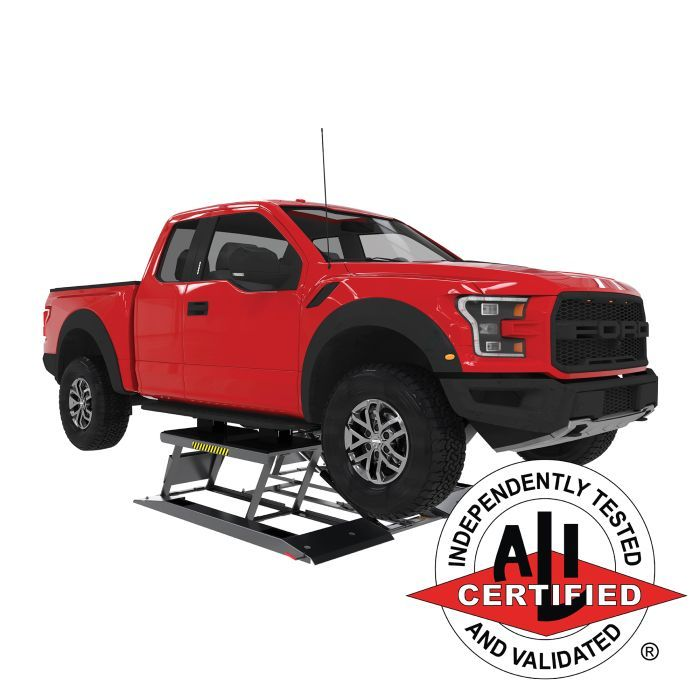
Features:
- Four parallelogram frame support bars on each platform
- Drive-over ramps and side rails for increased approach width
- Full-length rubber-topped lifting platform
- Eight multi-height rubber-topped adapters
- Storage trays on each side of the platform
- Dual hydraulic cylinders with 10,000-lb lifting capacity
- Diamond-plated approach ramps
- Three locking positions with hands-free safety lock release
- Powder-coat finish
- Zero-throw casters for maneuverability
- Stowable tow bar
- Rotary Solutions

Rotary Solution’s scissor-lift range covers low-rise pad lifts and full-rise models in frame-engaging and drive-on runway designs, including alignment variants. Typical capacities on passenger-vehicle scissor lifts include 10,000 lb for low-rise and 12,000–14,000 lb for full-rise runway units. Most models use an electric motor to power a hydraulic pump, and shops can install them as surface-mount or recessed flush-mount platforms to match bay layouts.

Features:
- Open front-to-rear access with no obstructions for alignment and repair points
- Optional LED light kits mounted inside runways to illuminate the undercarriage
- Floor-recessed or surface-mount installation options to fit the bay
- Single-phase electrical supply across models
- Electric motor and hydraulic cylinders provide lifting power
- Atlas
Atlas features low-rise pad lifts, portable mid-rise units, and full-rise runway designs for alignment:. The company’s models have capacities ranging from 6,000 lb to 7,000 lb for mid-rise units and 12,000–16,000 lb for alignment runways. There are various configurations to choose from, including open-center platforms and drive-on runways, with installation options available as surface-mount or recessed for a flush deck.

Features:
- Commercial grade
- Powder Coated
- Single-point manual lock release
- Free-standing, portable design
- Dual hydraulic cylinders
- 7 locking positions
- Truck adapters included
- Separate motor stand included
- Nussbaum
The Nussbaum scissor-lift lineup centers on one mobile mid-rise lift and two full-rise double-scissor models: the SPRINTER 7 (7,000 lb) and the JUMBO series at 7,000 lb and 9,000 lb. They all rise in a vertical path using electro-hydraulic power. The mobile mid-rise SPRINTER 7 includes length-adjustable platforms and a 4 1/8 in drive-on height, while the JUMBO models are double-scissor platforms with listed capacities and dimensions for bay planning.

Features:
- Fully mobile setup
- 360° vehicle access for body, tire, and paint work
- Length-adjustable mountings with one-hand locking and unlocking of ramps
- Hot-dip galvanized, anti-slip platforms resistant to corrosion and dirt
- Two independent hydraulic cylinders
- Integrated sub-oil hydraulic power unit for reliable, low-maintenance performance
- Delivered pre-assembled and factory-tested for functionality
- Titan Lifts

Titan Lifts offers automotive scissor lifts in mid-rise formats powered by electric-hydraulic systems. Models include the MRL-6000 (6,000 lb) and the PREMIER SL-6600 (6,600 lb), each designed to raise a vehicle on a vertical scissor mechanism. Both models use dual hydraulic cylinders powered by a dedicated power unit to elevate the platforms to working height, then lower under control when released.

Features:
- Solid steel construction with a durable powder-coated finish
- Freestanding mid-rise scissor design
- Portable 110V single-phase power unit mounted on a dolly
- Dual hydraulic cylinders
- Adjustable lift arms
- Full set of height adapters
- Low-profile setup to fit most vehicles
- Twin Busch
Twin Busch offers automotive scissor lifts in floor-mounted and under-floor formats for lifting passenger vehicles on a vertical scissor mechanism. Models in this line include full-rise double-scissor platforms with a 3.0-ton capacity and 1,850 mm lift height. Its drive-on scissor runways allow for level installation, combining an integrated wheels-free lift with an automatic safety-lock release and a shop-air connection in the 4–8 bar range.

Features:
- Manufactured according to ISO 9001
- Low drive over height
- Mechanical synchronization
- High quality solid construction
- Two powerful hydraulic cylinders
- Automatic safety lock
- Pneumatic release system
- Acoustic warning signal (foot protection)
- Challenger Lifts

Challenger lifts automotive scissor line covers mid-rise pad lifts and full-rise runway alignment lifts. Models include the SRM10 mid-rise (10,000 lb), a dual-scissor 7,700 lb platform lift, and the SX14 14,000 lb alignment scissor with drive-on runways. Mid-rise units raise vehicles on pads for quick service in tight bays. The SX14 provides a full-height, drive-on deck with turn-plate recesses and rear slip areas for wheel alignment; surface-mount and flush-mount installations are also supported.

Features:
- Reinforced diamond-plate front and rear ramps flip up and lock to extend platform load length for longer wheelbases
- Double-scissor lifting mechanism for taller rise and added working clearance
- Twin hydraulic cylinders
- Single-point, air-actuated safety lock release for setting working height
- Power unit console with three push-button controls
- Package includes two rolling bridge jacks, turn plates, and an airline kit for dual-jack operation
- Extra-wide runways accommodate single and dual rear-wheel vehicles
How to Choose the Best Scissor Lift
When choosing the best scissor lifts, here are a few factors to consider:
Consider Ease of Use
Ease of use directly impacts how smoothly work gets done in the bay. A scissor lift should feel intuitive from setup to operation, with clear controls, steady motion, and simple safety locks. When a lift takes extra steps to position or release, every job slows down.
Look for straightforward control panels with labeled buttons, a single lock release, and clear visual indicators. Low drive-on height helps prevent vehicle contact, while stable ramps and consistent platform motion improve confidence during loading. Adapters and blocks should be stored within reach so techs don’t waste time searching between jobs.
Maintenance access matters too. Grease fittings, hydraulic lines, and release valves should be easy to reach without dismantling panels. A lift that’s simple to inspect, clean, and service stays in rotation longer and reduces downtime.
Find a Dependable Battery System
A dependable battery system keeps the lift available and predictable. Consistent voltage under load means the platform rises at a steady speed, even with heavier vehicles or multiple cycles in a row, so techs don’t waste time waiting or restarting a lift that sags.
You also want a battery that lasts, shows its charge level clearly, and protects itself from things like overcharging or deep draining. That helps avoid random shutdowns and unexpected repair bills. Fast charging and simple battery swaps keep the bay moving during busy hours. In mobile or low-power setups, a solid battery setup often decides if you finish the job smoothly or end up rolling a car off the lift by hand.
Prioritize Safety
Safety determines how confidently a team can use a scissor lift. If safeguards are unclear or hard to use, even experienced technicians hesitate, and work slows. The goal is a clear, repeatable lift process with locks, controls, and markings that match how service actually happens in the bay.
A safety-first setup lowers the risk of drops, misloads, and uneven lifting. Features like positive mechanical locks, controlled-descent hydraulics, level keeping between platforms, and visible lift-point guides help new users learn faster and help seasoned techs avoid mistakes. When emergency-lowering steps are simple and daily checks are easy to perform, teams spend less time troubleshooting and more time finishing jobs without incidents.
Find the Best Scissor Lift Manufacturers and Brands
Choosing the right automotive scissor lift is a core equipment decision for any shop. Many models look similar, yet they differ in capacity, platform style, rise height, footprint, and site requirements that affect daily work. The right lift matches your vehicles, bay layout, and power supply. It fits the space, clears low cars, reaches a workable height, and supports the tasks you run most often, whether quick-service jobs or full alignment work.
A good fit also meets shop-specific needs such as wheelbase range, runway or pad style, bridge jacks for wheels-free work, low drive-on height, clear controls, and safety locks that techs engage every time. It’s important to pick a lift that aligns with your workflow, so you can have predictable cycle times, safer setups, and steady throughput.
Wrenchers stocks scissor lifts for both home garages and professional shops, including low-rise units for quick tire and brake work, mid-rise models for low-ceiling spaces, and full-rise lifts for complete undercarriage access. The lineup includes portable options, flush-mount and pit-style installs, and ALI-certified models from trusted brands like BendPak, Dannmar, and Norco, so you can match a lift to your space, vehicles, and budget instead of forcing your bay to fit the equipment.
Explore Scissor Lifts with Wrenchers
Scissor Lift Manufacturers and Brands FAQs
How do I rent a scissor lift?
You can rent a scissor lift through a shop-equipment rental provider. Start by contacting a rental outlet that lists scissor lifts for rent, confirm the capacity you need, and that your power and floor conditions match the model, then place a reservation and arrange delivery or pickup.
Many rental companies require proof of insurance or a rental protection plan (often via a certificate of insurance), so have that ready before the agreement is finalized. On delivery, review the operating manual and site requirements, and make sure only trained staff set up and use the lift.
Who makes the best scissor lift?
The dependable choice for your shop is the model that meets recognized vehicle-lift safety standards in your jurisdiction The lift should fit your capacity and rise requirements, match your power and floor conditions, and include clear operating instructions with training and inspection procedures.
Check in with your local rules that govern lift design and operation, verify documented maintenance and safe-use guidance, and make sure only trained operators use the lift. These factors matter more than a label on the front of the unit.
What is the OSHA rule for scissor lifts?
OSHA’s rules for scissor lifts are simple: the platform needs guardrails, workers must be trained, and the lift must be kept in good working shape. Use it only on firm, level ground, keep people and vehicles from bumping into it, and don’t drive it while raised unless the manual says you can. Follow the maker’s limits for weight, height, and wind, and stay at least 10 feet away from power lines.
How much does a 20 ft scissor lift weigh?
The exact weight changes by brand and setup. A lift with longer runways, heavier steel, or built-in alignment features will weigh more. Shipping weight can also be higher than installed weight because it includes crates, ramps, and packaging.
Add-on features can also increase the total weight. Rolling bridge jacks, lighting, or a flush-mount frame can push the total higher. If you need a precise figure for freight, check the model’s spec sheet and ask if the weight shown is shipping or installed.
Which is better, electric or hydraulic scissor lift?
Most vehicle scissor lifts are electro-hydraulic, so you probably won’t have to choose. An electric motor drives a hydraulic pump, which powers the cylinders that raise the scissor platforms; this is the standard design you’ll see across mainstream shop lifts. Manufacturer materials describe this setup on low-rise, mid-rise, and full-rise models . If you’re choosing between models, compare capacity, rise height, footprint/installation (surface or flush), and the available power supply at your shop.
